

Basketball Ending is a local betting practice in the Philippines where participants wager on the last digits of a basketball game’s score. It is most often tied to PBA games, and can apply either to the final score after regulation or to the score at the end of a specific quarter. The system relies on a simple grid of number combinations (0–0 through 9–9), with the winner’s last digit placed first and the loser’s last digit second. For example, if the final score is 89–74, the ending is read as 9‑4.
This practice matters because it is a popular form of informal street betting, drawing attention to the closing minutes of games and creating quick, high‑variance wagers. However, because rules vary by organizer—such as whether overtime counts, how payments are handled, and which score source is official—disputes are common. Clear conventions on ordering, overtime inclusion, and settlement procedures help reduce conflict and protect both bettors and organizers.
Mechanics of the Ending System
Before breaking down the technical rules, it helps to see how Basketball Ending actually works in practice. This betting format thrives on simplicity: bettors only care about the last digits of the score, yet those digits can flip outcomes dramatically. Because of its popularity in PBA games and neighborhood setups, clear conventions are essential. Below are the key mechanics that define how endings are read and settled.
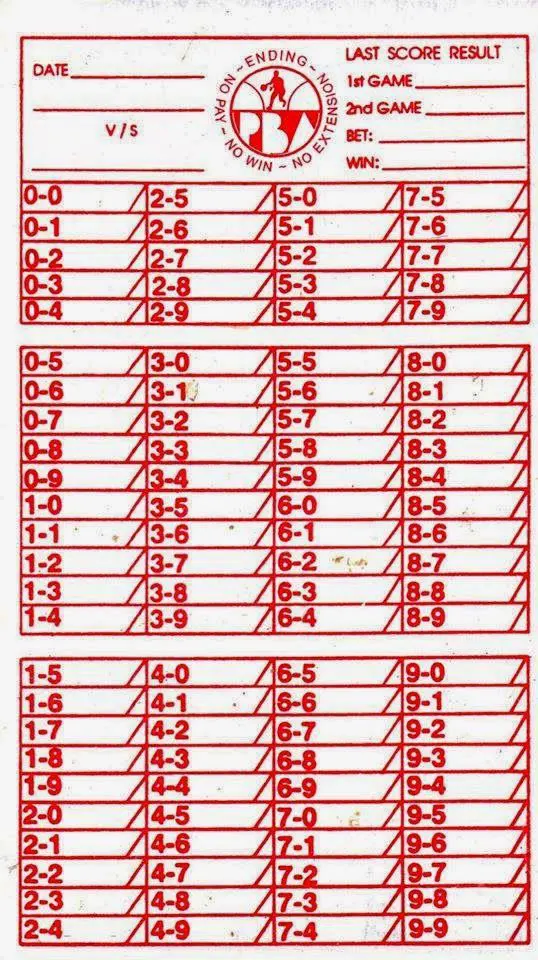
Ending Grid Explained
The ending grid is the foundation of Basketball Ending. It is a matrix of all possible two‑digit combinations from 0‑0 through 9‑9, representing every possible outcome of the last digits of a basketball score. To use it, you take the final score of the game (or quarter), extract the last digit of each team’s score, and then locate that pair on the grid.
- Example: If the final score is 89–74, the last digits are 9 and 4, so the ending is 9‑4.
- This grid ensures that every possible score outcome has a corresponding ending combination.
Winner‑First Convention
By default, the first digit always represents the winner’s last digit, while the second digit represents the loser’s last digit. This convention avoids confusion and standardizes how endings are read.
- Example 1: 89–74 → Winner = 89 → last digit 9; Loser = 74 → last digit 4 → Ending = 9‑4.
- Example 2: 101–99 → Winner = 101 → last digit 1; Loser = 99 → last digit 9 → Ending = 1‑9.
- Note: Some local setups may use a different system (like listed‑team order instead of winner‑first). If so, this must be announced clearly before bets open to prevent disputes.
Game Ending vs Quarter Ending
- Game Ending: Uses the official final score of the entire game. In most kanto setups, this means the regulation score only, unless overtime is explicitly included.
- Quarter Ending: Applies the same winner‑first rule to the score at the end of a specific quarter (Q1, Q2, Q3, or Q4).
- .
👉 In short, game endings are longer and often carry bigger potential payouts, while quarter endings are quicker but typically smaller. Bettors choose based on whether they prefer fast results or higher stakes with more suspense.
Overtime Rule (OT)
- Default: Overtime is excluded from game endings in most street/PBA setups. Settlement is based only on the regulation score.
- Inclusion: OT is counted only if the organizer/finder explicitly announces it before tip‑off and records it on the card.
- Impact: Including OT can completely change the ending.
- Example: Regulation score = 95–95 (tie, no clear ending).
- After OT = 103–101 → Ending becomes 3‑1.
- Best practice: Print or announce the rule: “OT excluded by default; include only if agreed and recorded before tip‑off.”
Why These Mechanics Matter
The clarity of the ending grid, winner‑first convention, and OT policy ensures that bettors and organizers avoid confusion. Without these rules, disputes can arise over how to read scores, whether overtime counts, or which scoreboard is authoritative. By standardizing these mechanics, Basketball Ending remains a simple, fast, and fair betting format.
Roles and Authority
In the informal system of Basketball Ending in the Philippines, authority is concentrated in the finder/organizer, who also acts as the collector. This person has the dual role of setting the rules and keeping records, ensuring the game runs smoothly. While technically considered illegal gambling under Philippine law, ending games are often tolerated socially because not everyone participates and enforcement is inconsistent.
- Finder/Organizer/Collector
- Chooses which basketball game will be used (commonly a PBA match).
- Announces the rules before tip‑off: overtime inclusion, ordering convention, official score source, and payment cutoff.
- Records each bettor’s pick, stake, and payment status, marking “Paid” or initialing the card.
- Settles payouts strictly according to the announced rules and the agreed score source.
- Bettors
- Accept the organizer’s rules and place their picks on the ending grid.
- Must pay before the cutoff; unpaid picks are void even if they win.
- Cannot change rules mid‑game; participation is conditional on the organizer’s framework.
Decision Flow: Organizer/collector sets and enforces rules → Bettors accept and pay → Settlement follows the official score source. Disputes are resolved by referring to the organizer’s announced rules and payment log.
Rules, Payment, and Settlement Procedures
In Basketball Ending, the rules must be clear before the game starts to avoid confusion and disputes. The organizer/collector carries the responsibility of announcing and enforcing these rules.
Pre‑game agreement
- Before tip‑off, the organizer must state whether overtime is included or excluded (default is excluded), confirm the ordering convention (winner’s last digit first), specify the official score source, and set the payment cutoff time. These rules should be announced or written so all bettors understand the framework.
Payment rule
- Bets are valid only if paid before the cutoff. Any unpaid pick is automatically void, even if it matches the winning ending. This prevents bettors from claiming wins after results are known.
Record keeping
- The ending card should include the organizer’s initials, the bettor’s chosen pick (e.g., 9‑4), the stake amount, and a Paid checkbox or collector’s initials to confirm payment. This log serves as proof and protects both bettors and the organizer in case of disputes.
Settlement
- The organizer must identify which scoreboard or boxscore is authoritative. If post‑game corrections occur, the organizer decides whether they apply, but this must be clarified before the game begins.
👉 In short, Basketball Ending relies on clear rules, upfront payments, and proper record keeping. These procedures ensure fairness in a system that, while technically illegal in the Philippines, continues to thrive informally because of its simplicity and community acceptance.
Common Issues and Disputes
Late payments and claims
- Bettors sometimes try to claim a win without paying before tip‑off.
- Rule: unpaid picks are void, no exceptions.
Score corrections and OT disagreements
- Official boxscore corrections can flip endings.
- Disputes arise if overtime inclusion/exclusion was not clearly announced.
Practical dispute resolutions
- Collector log is the primary reference for payment and picks.
- If rules were announced, follow them strictly.
- If records are unclear, void the disputed pick or return the stake to maintain fairness.
- Majority rule or organizer’s authority can resolve disagreements, but transparency is key.
Conclusion
Basketball Ending remains one of the most recognizable forms of informal betting in the Philippines. Its appeal lies in its simplicity: bettors only need to predict the last digits of a score, yet those digits can swing outcomes dramatically. With clear mechanics, defined roles, and strict rules on payment and settlement, the system has managed to thrive in local communities despite its informal nature.
However, it is important to emphasize that Basketball Ending is considered illegal gambling under Philippine law. The fact that authorities do not always pursue or penalize small neighborhood sessions does not mean it is “okay” to engage in. Rather, it reflects how this practice has become a tolerated pastime in certain areas — an old way for people to entertain themselves and, at times, earn extra money.
In the end, Basketball Ending is part of the cultural fabric of street betting in the country. But participants should always remember that its legality is questionable, and while it may be socially accepted in some circles, it is not officially sanctioned. Clear rules and transparency may reduce disputes, but they do not change its legal status. It remains a traditional, community‑based form of gambling that survives more as a social activity than as a legitimate enterprise.