

If you are just starting your journey at the tables, the first thing you must learn is what is the highest card in poker and how individual card values dictate the winner of a pot. While many players focus on flashy bluffs, the true foundation of the game lies in a technical understanding of the 52-card deck and the specific hierarchy of hands. Whether you are holding a single high card or a rare combination, knowing which ranks take precedence is the only way to make informed betting decisions.
In this comprehensive guide, we will break down the individual card rankings from the versatile Ace down to the lowly Deuce. We will also explore the “Category Beats Category” rule that governs the ten standard 5-card hand tiers—from the common One Pair to the elusive Royal Flush. By the end of this article, you will not only know the ranking of every hand but also the complex tie-breaking rules, such as the role of the “kicker” and why certain sequences are considered invalid.
Individual Card Rankings: From Ace to Deuce
In standard poker, the value of a hand is determined by its individual components. Understanding this hierarchy is the foundation of every winning strategy.
The Card Hierarchy
There are 13 distinct ranks in a standard 52-card pack. When comparing individual cards, we follow this descending order: Ace, King, Queen, Jack, 10, 9, 8, 7, 6, 5, 4, 3, 2.
- The Power of the Ace: The Ace is the most versatile card in the deck. In almost all scenarios, it acts as the highest individual card, outranking the King.
- The Face Cards (Court Cards): Ranking follows traditional royal hierarchy—King (K) is highest, followed by Queen (Q) and Jack (J).
- The Numbered Cards: These are valued by their face value. The 10 is the strongest, while the 2 (the “Deuce”) is the lowest card in the entire deck.
The “Low Ace” Exception
While the Ace is typically the “ceiling,” it can also act as the “floor” in specific sequences:
- The Wheel: In the straight 5-4-3-2-A, the Ace represents the value of 1. In this case, the 5 is the “top” card of the sequence, making it the lowest possible straight.
The Hierarchy of 5-Card Poker Hands
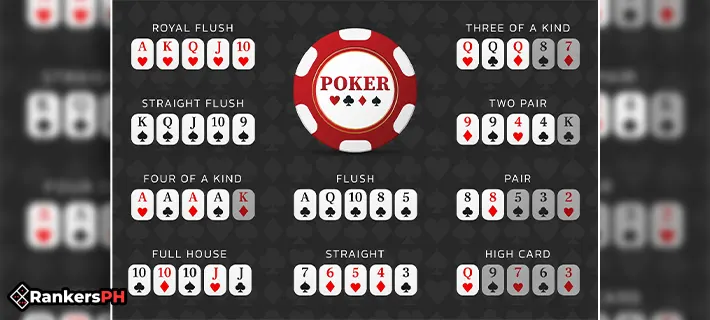
The “Category Beats Category” Rule states that any hand in a higher category automatically defeats any hand in a lower one. For example, a Three of a Kind of 2s always beats a Two Pair of Aces.
Shutterstock
Tier 1: The Undisputed Champions
- Royal Flush: The ultimate hand (A-K-Q-J-10 of the same suit). All suits are equal, so all Royal Flushes result in a tie.
- Straight Flush: Five cards of the same suit in numerical sequence.
Tier 2: Multiples and Matching Sets
- Four of a Kind: Four cards of identical rank.
- Full House (The “Boat”): Three cards of one rank and two of another (e.g., Sevens full of Tens).
Tier 3: Composition Hands
- Flush: Any five cards of the same suit, not in sequence.
- Straight: Five cards in numerical sequence of mixed suits.
Tier 4: Pairs and Matches
- Three of a Kind: Three matching ranks plus two unrelated cards (kickers).
- Two Pair: Two different pairs and one kicker.
- One Pair: Two cards of the same rank and three kickers.
Tier 5: High Card
- High Card: When no combinations are formed, the highest individual card determines the winner.
Tie-Breaking Rules: Who Wins When Hands Match?
When two players hold hands from the same category, these rules identify the winner:
- Top Card Advantage: In Straights or Flushes, the hand with the highest-ranking top card wins.
- The Role of the “Kicker”: In Pairs or Three of a Kind, if the matching sets are equal, the “odd” cards (kickers) are compared in descending order until a winner is found.
- The “Turn the Corner” Constraint: An Ace can be the highest (A-K-Q-J-10) or lowest (5-4-3-2-A), but it cannot link the two. This means sequences like 4-3-2-A-K are invalid.
Summary Table: Hand Ranking Quick Reference
| Rank | Hand | Tie-Breaker |
| 1 | Royal Flush | Always a tie (all suits are equal). |
| 2 | Straight Flush | The highest top card. |
| 3 | Four of a Kind | The rank of the four cards; then the 5th card kicker. |
| 4 | Full House | The rank of the three cards; then the rank of the pair. |
| 5 | Flush | The highest card, then 2nd, 3rd, 4th, and 5th. |
| 6 | Straight | The highest top card (Ace can be high or low). |
| 7 | Three of a Kind | The rank of the three cards; then the highest kicker. |
| 8 | Two Pairs | The highest pair, then the second pair, then the kicker. |
| 9 | One Pair | The rank of the pair, then the 1st, 2nd, and 3rd kicker. |
| 10 | High Card | The highest card, then 2nd, 3rd, 4th, and 5th. |
Conclusion
We have summarized the core principles of the game into a single, cohesive overview. Mastering the hierarchy of a standard 52-card deck is the essential first step for any player, as it dictates how individual values and complex combinations decide the winner of every pot. From the versatile Ace—which serves as both the highest individual card and the foundational “1” in a low straight—to the undisputed power of the Royal Flush, understanding these tiers allows you to navigate the “Category Beats Category” rule with confidence. By internalizing these rankings along with technical tie-breaking factors like the “kicker” and the “turn the corner” restriction, we ensure that you can accurately assess hand strength and make strategic betting decisions at any table.
Frequently Asked Questions
The Ace is typically the highest card but has a “dual-rank” ability, acting as a “1” to complete the lowest possible straight (5-4-3-2-A).
No, all suits are equal; if two players have identical hands in different suits, the pot is split.
The winner is decided by the “Kicker,” which is the highest-ranking unrelated card in the five-card hand.
It is based on mathematical probability, as a Flush is statistically rarer and harder to achieve than a Straight.
No, a straight must be linear; the Ace can only be at the very top or the very bottom, meaning sequences like $Q-K-A-2-3$ are invalid.