

What is poker card game is more than just a pastime — it’s a structured contest of skill, chance, and strategy. To understand it fully, you need to know the essentials: the deck or “pack” used, the ranking of poker hands, the betting mechanics, the flow of gameplay, and the key variations that shape each session. From the rotation of decks in formal play to the psychological depth of bluffing, poker combines tradition with tactical decision‑making.
The Pack in What is Poker Card Game
Poker is traditionally played with a standard 52‑card deck, sometimes with jokers depending on the variation. While it is essentially a one‑pack game, many clubs and professional tables use two contrasting decks to keep the action moving quickly.
The system works like this: while one pack is being dealt, the previous dealer shuffles the other and prepares it for the next round. This rotation ensures smooth gameplay and minimizes downtime. In formal settings, new decks are introduced in full view of all players, with seals and wrapping broken openly to maintain fairness and transparency.
Poker Hands (Ranking Basics)
To fully grasp what is poker card game, you need to understand how hands are ranked. Poker hands decide the winner, and the rarer the combination, the stronger it is:
- Five of a Kind – Highest possible hand (requires wild cards).
- Straight Flush / Royal Flush – Five cards in sequence, same suit; Royal Flush is A‑K‑Q‑J‑10.
- Four of a Kind – Four cards of the same rank.
- Full House – Three of one rank plus two of another.
- Flush – Five cards of the same suit, not in sequence.
- Straight – Five cards in sequence, mixed suits.
- Three of a Kind – Three cards of the same rank.
- Two Pair – Two different pairs plus one extra card.
- One Pair – A single pair with three unmatched cards.
- High Card (No Pair) – No combination; the highest card decides the winner.
👉 For more understanding of card rankings, check this guide: What is the Highest Card in Poker? Understanding Card Rankings
Basic Betting
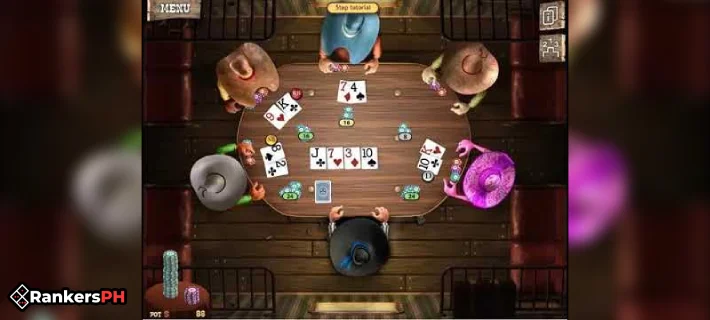
In what is poker card game, betting is the central mechanic that drives the action. Every round begins with an ante, the initial contribution to the pot. From there, players decide how to act: they can call to match a bet, raise to increase the stakes, fold to drop out, or check to stay in without betting if no one else has acted yet.
The round continues until all bets are equalized, leading to a showdown where remaining players reveal their hands. The strongest hand wins the pot. Importantly, poker isn’t just about the cards — bluffing allows a player to win by convincing others to fold, even without holding the best hand.
Quick Reference
| Element | Explanation |
| Ante | Initial contribution each player makes to start the pot. |
| Call | Match another player’s bet to stay in the round. |
| Raise | Increase the bet amount, forcing others to match or fold. |
| Fold | Drop out of the round, losing any chips already placed in the pot. |
| Check | Stay in the game without betting, allowed only if no one has bet yet. |
Gameplay Flow
To understand what is poker card game, here’s how a typical round flows:
- Cards Dealt – Players receive cards (Draw = face down, Stud = some face up).
- Betting Rounds – Players bet, call, raise, fold, or check until bets are equalized.
- Showdown – Remaining players reveal hands; best hand wins the pot.
- Dealer’s Choice – Dealer may set rules for the round, including ante size or wild cards.
Key Variations
Poker isn’t played in just one way. To fully understand what is poker card game, it helps to look at the most common variations that shape how the game unfolds.
Draw Poker
All cards are dealt face down. Players can discard and draw new cards to improve their hand, making it a game of hidden strategy and careful decision‑making.
Stud Poker
Some cards are dealt face up for everyone to see. This open style adds psychological depth, since betting decisions are influenced by the visible strength of opponents’ hands.
Wild Cards
Optional rules allow certain cards — like jokers, deuces, or one‑eyed jacks — to act as wild. These can represent any rank or suit, dramatically increasing the chances of rare hands such as Five of a Kind or a Straight Flush.
Conclusion
Poker remains one of the most enduring and dynamic card games because it balances luck with human strategy. By learning the pack, mastering hand rankings, understanding betting basics, following the gameplay flow, and exploring variations like Draw or Stud, players gain a complete view of what is poker card game. At its core, poker is not only about the cards dealt but also about how players read situations, manage risks, and seize opportunities — making every round a unique battle of skill and psychology.