

What is Poker? Poker is a globally recognized card game that combines skill, psychology, and strategy with the thrill of competition. From its roots in European bluffing games to modern casino tables and online platforms, poker has evolved into a discipline where players aim to outwit opponents, master betting rounds, and build winning hands.
Today, poker is more than casual entertainment—it is celebrated as a competitive pursuit. Professional players earn recognition for their mastery, tournaments like the World Series of Poker attract worldwide audiences, and organizations continue to push for its classification as a mind sport, highlighting its legitimacy on the global stage.
Basics of Poker
Poker is a card game where players compete to win chips by forming the strongest hand or convincing opponents to fold. Popular variants like Texas Hold’em and Omaha share the same foundation: card rankings, betting rounds, and strategic play.
👉 Learn more: What is Poker Card Game? Basics and Gameplay Explained
Standard Deck and Card Values
Poker uses a 52‑card deck with four suits: hearts, diamonds, clubs, and spades. Cards are ranked from Ace (highest) down to 2 (lowest). Suits are equal in value but matter when forming hands like flushes. High cards often decide close games, while low cards can complete straights or pairs.
Betting Rounds and Player Actions
Players act strategically during betting rounds:
- Check – pass without betting
- Bet – place chips in the pot
- Raise – increase the bet
- Fold – exit the hand
In Texas Hold’em, betting occurs across four stages: Pre‑flop, Flop, Turn, and River.
What is a Value Card in Poker?
A value card strengthens your hand or increases its winning potential. Examples:
- An Ace beating a King in a high‑card showdown
- A 10 completing a straight (7‑8‑9‑10‑Jack)
Recognizing value cards helps beginners decide when to bet for profit versus when to bluff.
👉 Full guide: What is a Value Card in Poker? Key Concepts for Beginners
Poker Hands and Rankings
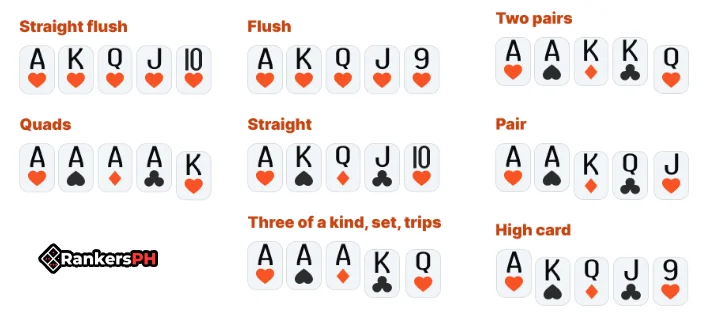
Poker is built on the strength of hands, and knowing how they rank is essential. From the simplest High Card to the unbeatable Royal Flush, hand hierarchy determines who wins each round.
Hand Hierarchy in Poker
Hands progress from High Card through pairs, straights, and flushes, up to the Royal Flush, the rarest and most powerful hand.
👉 For a detailed breakdown, see What is the Highest Card in Poker? Understanding Card Rankings.
What is a Flush in Poker?
A flush occurs when all five cards share the same suit. Example: 2♠, 7♠, 9♠, J♠, K♠. Flushes beat straights but lose to full houses and four of a kind. The highest card in the flush determines its strength.
What is the Best Hand in Poker?
The strongest possible hand is the Royal Flush: Ace, King, Queen, Jack, and 10 of the same suit. It’s unbeatable and extremely rare.
Key Poker Terms and Rounds
Poker isn’t just about the cards—it’s about the rhythm of play and the terms that define each stage.
Flop, Turn, and River Explained
- Flop – First three community cards dealt face‑up.
- Turn – Fourth community card, also called “Fourth Street.”
- River – Fifth and final community card, known as “Fifth Street.”
👉 For a deeper look, see What is a River Card in Poker? The Final Betting Round.
Importance of Position and Timing
- Position – Acting later in a round gives more information about opponents’ moves.
- Timing – Choosing when to bet, raise, or fold can be as powerful as the cards themselves.
Variants of Poker
Poker has evolved into many formats, each offering unique strategies and experiences.
Texas Hold’em (Most Popular)
Players receive two private “hole cards,” and five community cards are revealed in stages. The goal is to make the best five‑card hand using any combination.
Omaha, Stud, and Other Formats
- Omaha – Players receive four hole cards and must use exactly two with three community cards.
- Stud Poker – Players receive a mix of face‑up and face‑down cards, with no community cards.
- Other Variants – Razz, Pineapple, and mixed formats (HORSE) add variety.
Three Card Poker
A fast‑paced casino variant where players are dealt three cards and compete against the dealer.
👉 Full rules guide: What are Three Card Poker Rules? Gameplay and Rules Explained
Poker in Casinos
Poker is one of the few casino games where players compete against each other rather than the house. Still, casinos have structured ways to profit from hosting poker tables and tournaments.
How Do Casinos Make Money on Poker?
Casinos earn through:
- Rake – A small percentage taken from each pot.
- Tournament fees – Entry fees charged to players.
- House edge in variants – Games like Three Card Poker include built‑in odds favoring the house.
Cash Games vs. Tournaments
- Cash games – Players buy chips with real money and can leave anytime.
- Tournaments – Players pay a fixed entry fee, compete until one winner remains, and prizes are distributed based on finishing position.
History and Evolution
Poker’s history stretches back to 16th‑century Europe, where games like primero in Spain and poque in France introduced early versions of betting, bluffing, and flushes. By the early 1800s, French settlers brought poque to New Orleans, and English‑speaking Americans adapted it into “poker.” The game quickly evolved: by 1834 it used the modern 52‑card deck, and innovations such as straights, draw poker, and stud poker emerged—especially during the Civil War, when soldiers popularized it across the country. By the late 19th century, poker was firmly established in saloons of the American West and began spreading internationally, reaching Europe through U.S. diplomats and soldiers.
In the 20th century, poker grew from a gambling pastime into a mainstream card game, culminating in the creation of the World Series of Poker (WSOP) in 1970, which elevated it to global competition. Televised tournaments, the hole‑card camera, and the online poker boom of the early 2000s—sparked by Chris Moneymaker’s 2003 WSOP win—brought millions of new players into the game. Today, poker thrives both in casinos and online platforms, blending centuries of tradition with modern technology and continuing to evolve as both entertainment and competitive sport.
Poker as Competition
Poker has moved beyond casual play, increasingly recognized as a competitive discipline requiring skill, strategy, and endurance. Many argue it qualifies as a sport because it involves competition, organized events, and mastery that goes beyond chance. Professional players are celebrated for their skill, tournaments attract global audiences, and organizations continue to push for poker’s recognition as a mind sport.
| Aspect | Explanation |
| Skill Recognition | Professionals are celebrated for mastery, strategy, and consistency. |
| Tournaments | Events like the World Series of Poker attract global audiences. |
| Organizations | Efforts to classify poker as a mind sport highlight its legitimacy. |
Conclusion
Poker’s journey from its European origins to today’s global stage shows how a simple card game has transformed into a discipline of skill, psychology, and competition. Its evolution through saloons, casinos, televised tournaments, and online platforms highlights not only its adaptability but also its enduring appeal across generations and cultures.
More than entertainment, poker now stands as a recognized competitive pursuit. With professional players celebrated for mastery, tournaments drawing worldwide audiences, and organizations advocating for its status as a mind sport, poker continues to thrive as both tradition and modern competition—proving that its legacy is far from just a game of chance.


